AI Auto-Answers or Real Q&A? What Actually Earns Trust on a Shopify Product Page

· 7 min read
Kinnari
Chief Marketing Officer

AI auto-answers or real Q&A — what earns trust on a Shopify product page

A new kind of app landed on the Shopify App Store this year: paste in your product data, and an AI answers every shopper question on the product page by itself. No moderation, no waiting, no work. InstantQ is one of the newest — it "instantly delivers accurate answers using product knowledge automatically learned from your product pages." For a store with 4,000 SKUs and nobody to staff a support inbox, that sounds close to magic.

Your First 100 Product Reviews: Why New Shopify Stores Don't Need a 130-Feature Review App

· 9 min read
Kinnari
Chief Marketing Officer

AC ‑ Reviews & Ratings for Shopify

👉 Fix your store's Reviews & Ratings App now: Install AC ‑ Reviews & Ratings on the Shopify App Store →

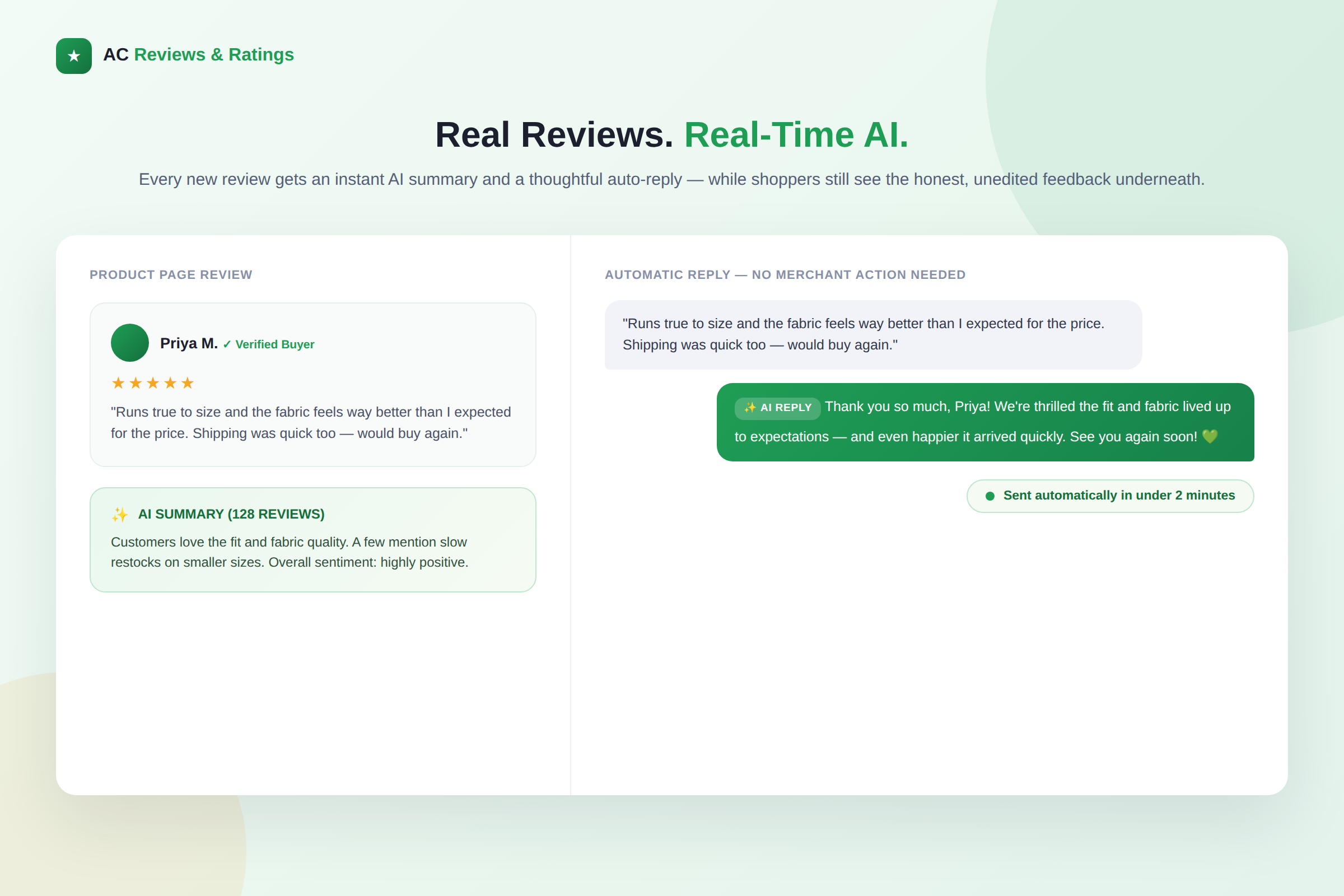
Here's the uncomfortable truth about product reviews on Shopify: 91% of consumers read online reviews before buying (PowerReviews), products with reviews see 270% higher conversion rates than those without (Spiegel Research Center), and displaying just 5 reviews increases purchase likelihood by 270%.

Yet the average new Shopify store has zero reviews on most products.

The instinct is to install the biggest, most feature-rich review app available. Judge.me has 41,000+ reviews. Loox has 8,000+. They must be the answer, right?

Not necessarily. If your store has fewer than 100 total reviews, you don't need Google Shopping syndication, AI-generated review summaries, 16 different widget types, coupons, referrals, QR codes or 130+ integrations. You need exactly one thing: a fast, simple way to collect and display reviews on your product pages.

Taggify vs. Leap Auto Tags: Which Shopify Tagging App Actually Fits Your Store in 2026?

· 6 min read
Kinnari
Chief Marketing Officer

Taggify – Customer & Orders Auto Tagging for Shopify

You've got a tagging job to do — flag wholesale buyers, mark repeat customers, stamp every order with the discount code it used — and two apps keep coming up: Leap Auto Tags and Taggify. They look close enough on the surface that most merchants just install whichever one they clicked first. That's a mistake, because they charge in completely different ways, and the wrong one can cost a small store real money for tags it barely uses.

Shopify Stores Have 33% More Accessibility Errors Than Average — Here's the 2026 Data (And a $4.99 Fix)

· 10 min read
Kinnari
Chief Marketing Officer

AC ‑ Accessibility Toolkit for Shopify

👉 Fix your store's accessibility now: Install AC ‑ Accessibility Toolkit on the Shopify App Store →

Every year, WebAIM scans the top 1,000,000 websites for accessibility errors. Their 2026 report just dropped — and the results for ecommerce are brutal.

Shopify stores average 75.1 accessibility errors per home page. That's 33.9% more errors than the web-wide average of 56.1 errors per page. Shopping sites in general scored 71.0 errors — 26.6% above average. Only sports sites performed worse in the entire study.

If you're running a Shopify store, your site is statistically one of the least accessible on the internet. That has real consequences: lost customers, legal exposure, and invisible revenue leaking out every day.

81% of Shoppers Abandon Products Without Answers — Here's How Product Q&A Fixes Your Conversion Rate

· 12 min read
Kinnari
Chief Marketing Officer

AC ‑ Questions & Answers for Shopify

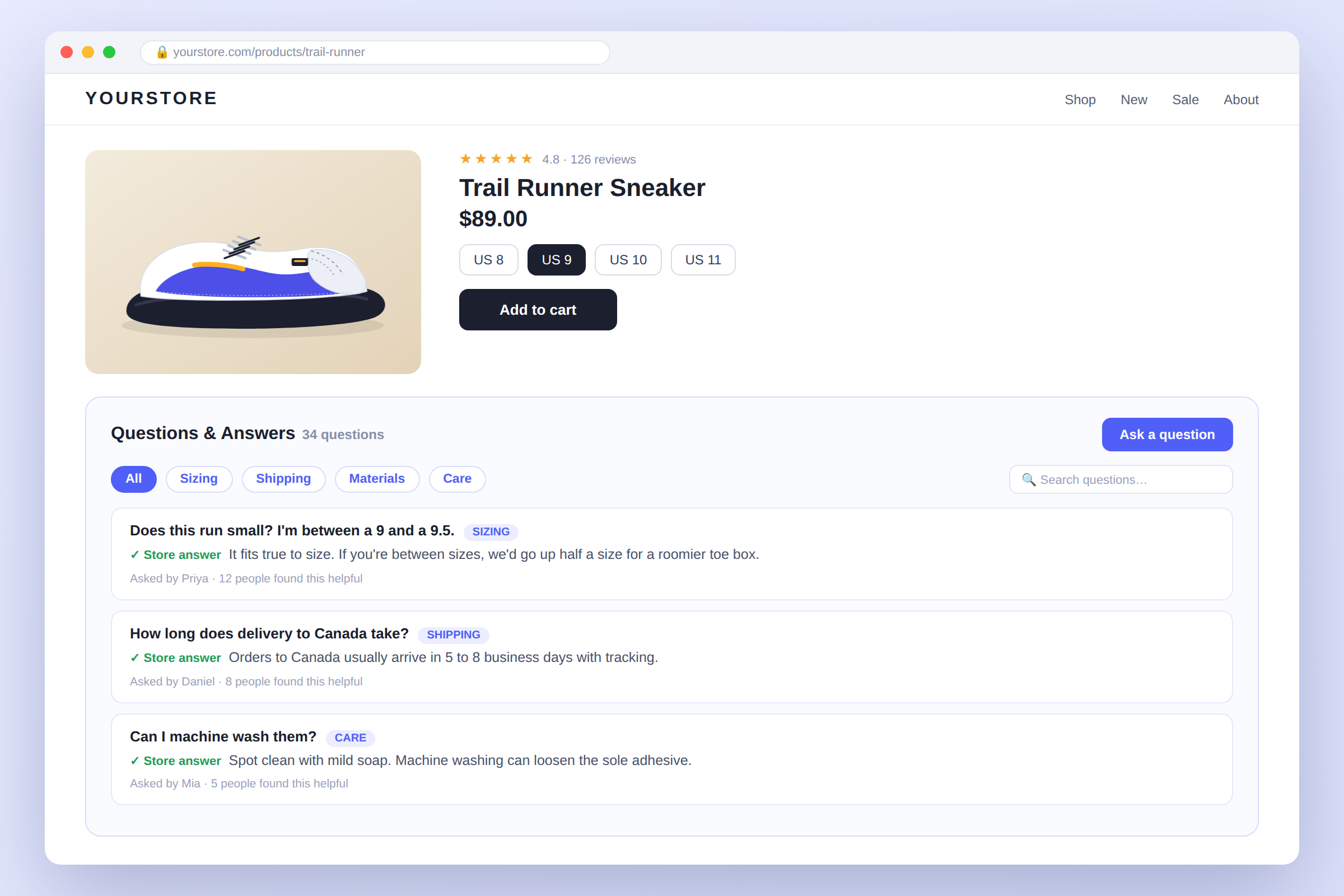
Here's a stat that should keep every Shopify merchant up at night: the average global ecommerce conversion rate is just 1.58% (IRP Commerce, 2025). That means for every 100 visitors to your store, roughly 98 leave without buying.

Why? The top reasons aren't price or shipping. They're unanswered questions. A Forrester study found that 53% of US online adults are likely to abandon their purchase if they can't find a quick answer to their question. And according to Google's retail research, 81% of shoppers conduct online research before making a purchase decision — if the answers aren't on your product page, they'll find them on a competitor's.

The solution isn't a $50/month chatbot. It's a product Q&A section that answers pre-purchase questions right on the page where buying decisions happen.

Record Accessibility Lawsuits in 2026: What Every Shopify Store Needs to Know (and Do)

· 8 min read
Kinnari
Chief Marketing Officer

Record accessibility lawsuits in 2026 — what every Shopify store needs to do

A law firm finds your store. A bot runs an automated scan, flags a handful of WCAG failures, and a demand letter lands in your inbox a week later. No warning, no customer complaint — just a settlement number. That's how most accessibility cases start now, and online stores are the favorite target.

We build accessibility tooling for a living, so we watch these numbers closely. They got worse in 2025, and 2026 is on track to beat them. The good news, and we'll show our work on this: getting to a defensible level of compliance is cheaper and faster than almost any merchant expects.

Meta's Official WhatsApp App vs Bizify: Which Shopify WhatsApp App Actually Does More?

· 8 min read
Kinnari
Chief Marketing Officer

Bizify ‑ WhatsApp chat for Shopify

WhatsApp has 2.78 billion monthly active users worldwide (Statista, 2026). For Shopify merchants, it's the fastest way to reach customers where they already spend hours every day.

But here's the problem: Meta launched their official WhatsApp app for Shopify in July 2025 — and merchants are already hitting its limitations. Reviews call it "very limited," "no option to create new templates," and "no option to contact support."

So what's the alternative? Bizify – WhatsApp Chat does everything Meta's app does, plus a customizable storefront chat widget, multi-channel support, cart recovery, and custom templates — for just $1.99/month.

Let's break down the real differences.

SchedulSmart vs Xyla AI: Best Shopify Social Media Auto-Post App in 2026 (Honest Comparison)

· 8 min read
Kinnari
Chief Marketing Officer

Taggify – Customer & Orders Auto Tagging for Shopify

Social commerce is projected to hit $1 trillion by 2028 (Accenture). Shopify merchants who don't automate their social media posting are competing with one hand tied behind their back.

Two apps dominate the conversation: SchedulSmart – AI Auto Post and Xyla AI Social Media Autopilot. But which one actually delivers better value for your store?

This comparison breaks down features, pricing, platform coverage, and real limitations so you can make an informed decision.

10 Customer Tagging Rules Every Shopify Store Needs in 2026 (Copy These Automations)

· 7 min read
Kinnari
Chief Marketing Officer

Taggify - Customer & Orders for Shopify

Personalized marketing drives up to 25% of total brand revenue (McKinsey). Yet most Shopify merchants still treat all customers the same — sending identical emails to first-time buyers, VIPs, and at-risk churners alike.

The fix? Customer and order tags. Tags are the foundation of Shopify segmentation. Get them right, and your email campaigns, discount strategies and fulfillment workflows become dramatically more effective.

Here are 10 tagging rules you can set up today — no coding required.

FitMagik for Shopify's Video-First AI Shopping Era

· 4 min read
Kinnari
Chief Marketing Officer

FitMagik: AI Virtual Try-On for Shopify

Install FitMagik: AI Virtual Try-On on Shopify

Introduction

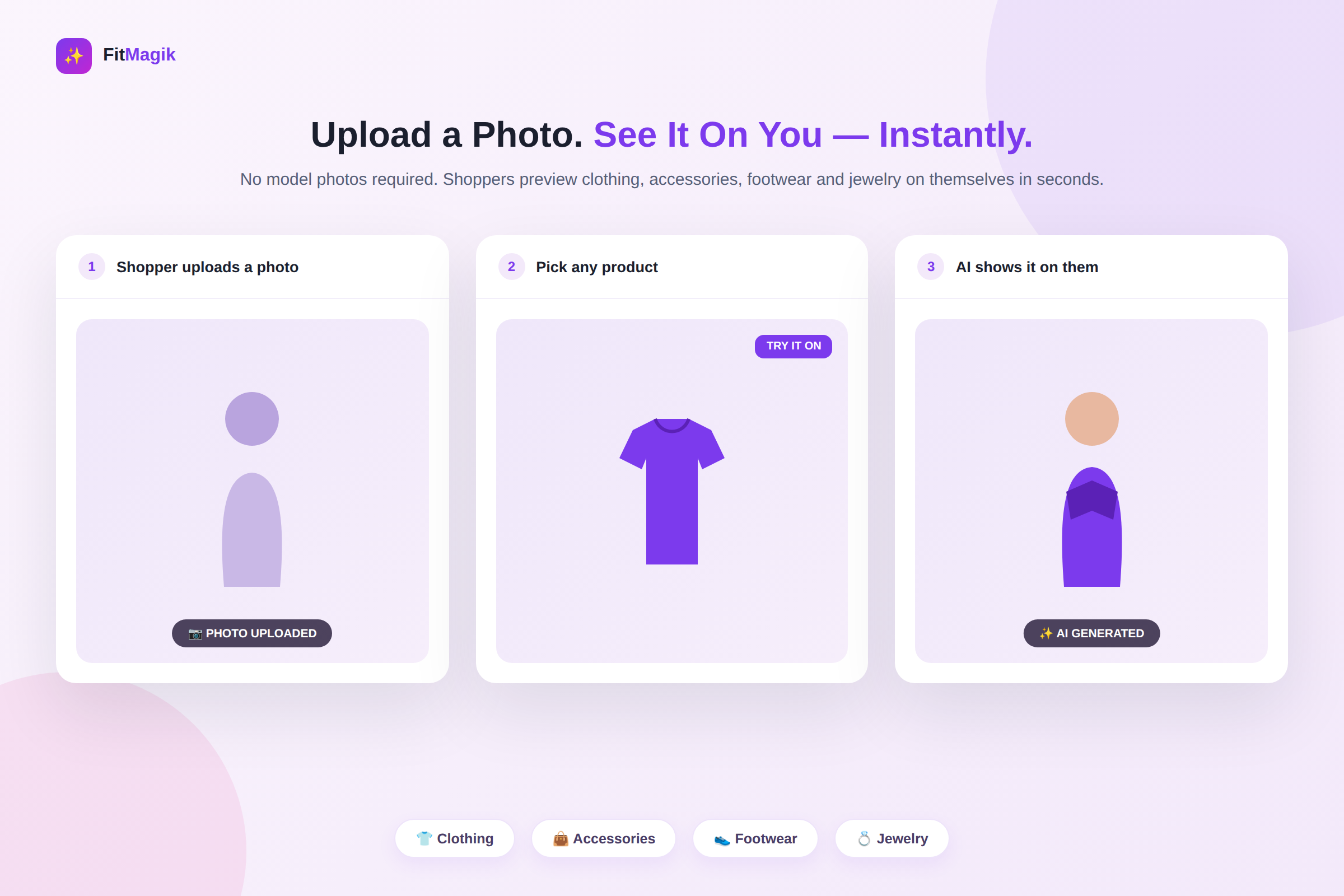
Shoppers are spending more time with short-form video, creator walkthroughs, and AI-assisted product discovery. That changes what they expect from a product page. A static photo gallery is still useful, but it is no longer always enough to answer the most important shopping question:

Will this actually look right on me?

That is where FitMagik: AI Virtual Try-On fits in. For merchants selling apparel, accessories, footwear, or jewelry, it adds a more interactive layer to the product page and helps turn curiosity into confidence.